Discontinued shingles are one of those things that seem simple until you’re actually in the middle of the claim.
The roof has damage. The carrier writes for a repair. The homeowner expects the roof to look right. And now you’re stuck trying to explain why the shingle they want you to use either doesn’t exist anymore or doesn’t match what’s on the roof.
That’s where a lot of roofers get jammed up.
Because the issue usually isn’t just, “This shingle is discontinued.”
The issue is: can the roof actually be repaired the way the estimate was written?
And if the answer is no, you need the documentation to prove it.
Why Discontinued Shingles Become a Problem
A discontinued shingle creates a problem because the original material may no longer be available. That means the carrier may write for a small repair, but the contractor can’t complete that repair in a way that looks right or makes sense.
This happens all the time on older roofs, storm-damaged slopes, discontinued colors, discontinued profiles, and shingles that are no longer carried through regular suppliers.
The carrier may see it as a repair.
The homeowner sees the whole roof.
And the contractor is the one who has to stand in the driveway and explain why one section of the roof may look different than everything else.
That is not a fun conversation.
“Close Enough” Is Usually Where the Pushback Starts
One of the most common things carriers will say is that there is a similar shingle available.
And sometimes, on paper, there is.
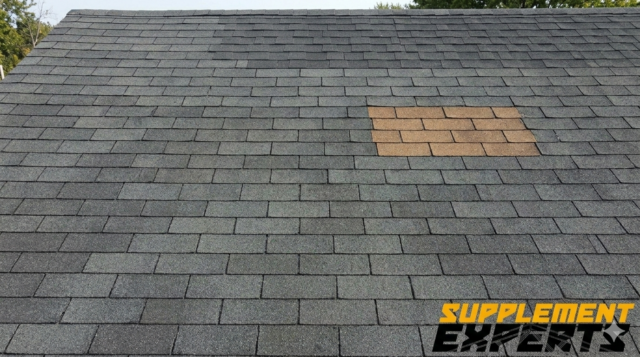
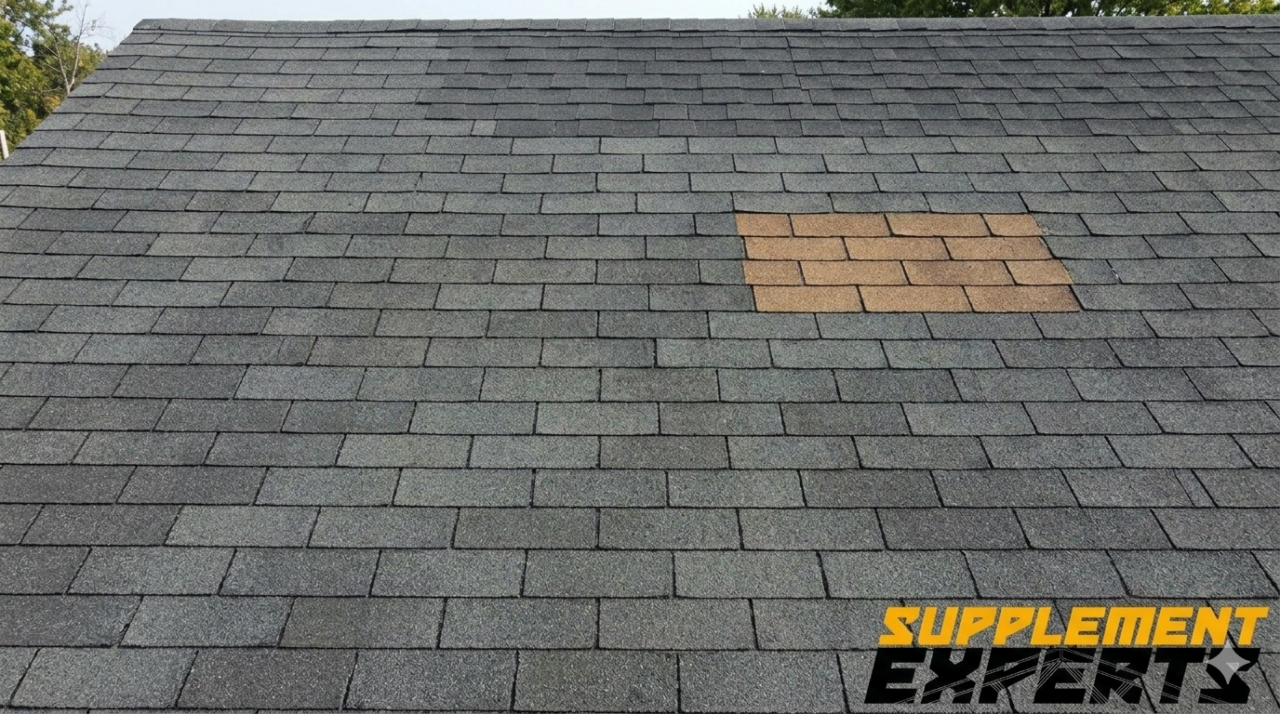
But paper doesn’t show what that shingle looks like installed next to a 12-year-old roof that has been sitting in the sun, hit by hail, and weathered through every season.
A shingle can be the same general color and still not match.
It can have a different profile. Different granule blend. Different exposure. Different shadow line. Different manufacturer. Different age. Different everything once it’s actually on the roof.
That’s where contractors need to slow down and build the file correctly.
You can’t just say, “It won’t match.”
You need to show why it won’t match.
What You Need Before You Submit the Supplement
Before you send in a discontinued shingle supplement, you need your documentation lined up.
That starts with clear photos.
You want close-ups of the existing shingles, photos of the damaged areas, slope photos, elevation photos, and anything that shows the condition of the roof. Don’t just take one picture from the ground and call it good.
You also want any manufacturer information you can get. If there’s a wrapper, product label, invoice, install record, supplier note, or anything that helps identify the shingle, keep it in the file.
A shingle identification report can be a big help too. If you have an ITEL report or another shingle ID report showing the shingle type, color, manufacturer, or availability, include it.
Measurements matter too.
If you’re asking for more than a small repair, the estimate needs to be supported by accurate measurements and a clear explanation of what areas are affected.
The goal is simple: make the file easy to understand.
What’s damaged?
What’s on the roof now?
Is that product still available?
Can it be matched?
Can the approved repair actually be completed correctly?
If the file doesn’t answer those questions, you’re giving them room to push back.
A Strong Supplement Needs More Than One Sentence
A lot of contractors are right about the shingle being discontinued, but they still don’t get anywhere because the supplement is too thin.
They submit something that basically says, “Shingle is discontinued. Replace more roof.”
That’s not enough.
A strong supplement should be built like a case file.
It should include the original scope, updated estimate, damage photos, roof measurements, shingle ID details, supplier information if you have it, and a clear explanation of why the original scope is missing what’s needed.
You’re not just asking for more money.
You’re showing why the current estimate doesn’t match the reality of the job.
That difference matters.
Why These Requests Get Pushed Back
Most discontinued shingle requests get pushed back for the same reasons.
The photos aren’t good enough.
There’s no shingle ID report.
There’s no explanation of why the repair won’t work.
The estimate doesn’t connect the requested items to the actual roof conditions.
The contractor jumps straight to a larger scope without walking through the logic.
When that happens, the carrier can say no pretty easily.
Not always because the contractor is wrong, but because the file doesn’t give them enough to work with.
That’s the part a lot of contractors miss. Being right is not always enough. You still have to prove it in a way that moves the claim forward.
When a Repair Turns Into a Bigger Roof Scope
A discontinued shingle does not automatically mean the whole roof gets bought.
That’s important.
But there are plenty of situations where the original repair scope just does not make sense.
If the damaged area can’t be repaired with a matching product, if the available replacement creates a visible mismatch, or if the slope cannot be repaired properly based on the condition of the roof, then the scope may need to be reviewed again.
This is where documentation makes or breaks the file.
The better the photos, measurements, reports, and explanation, the stronger the supplement.
The weaker the file, the easier it is for the carrier to keep the original repair scope in place.
How Supplement Experts Helps Contractors With Discontinued Shingles
This is exactly the kind of thing we help contractors with every day.
At Supplement Experts, we review the file, look at the original scope, check the photos, review the measurements, and identify what’s missing before the supplement goes in.
If the file needs a better shingle report, better photos, more roof details, or a clearer explanation, we’ll help point that out.
Then we build the roofing supplement in a way that actually supports the request.
We’re not just throwing line items on an estimate and hoping something sticks. We’re trying to make the file clear, clean, and defensible so it has a better shot at getting reviewed the right way.
And once it’s submitted, we help with the follow-up too, so you’re not stuck chasing emails and calls while also trying to sell jobs, manage crews, and keep homeowners happy.
Don’t Let a Discontinued Shingle Stall the Job
A discontinued shingle issue can hold up a job fast.
The homeowner wants answers. The carrier may be pushing for a repair. Your team is trying to keep the project moving. And every day the file sits, it creates more stress.
The way through it is documentation.
Show the damage. Identify the shingle. Prove the availability issue. Explain the repairability problem. Support the supplement with photos, reports, and measurements.
That’s how you give the file a real chance.
Because a discontinued shingle issue is not just a material problem.
It’s a scope problem.
It’s a documentation problem.
And it’s a communication problem.
Handled the right way, it can be moved forward. Handled the wrong way, it can cost you time, money, and trust with the homeowner.
Need Help With a Discontinued Shingle Claim?
Dealing with a discontinued shingle issue?
Send us the scope, photos, and shingle report. We’ll help you see what’s missing and what needs to be supplemented.
Start the conversation by filling out our short form, emailing us at info@supplementexperts.net, or giving us a call at (720) 307-6828.